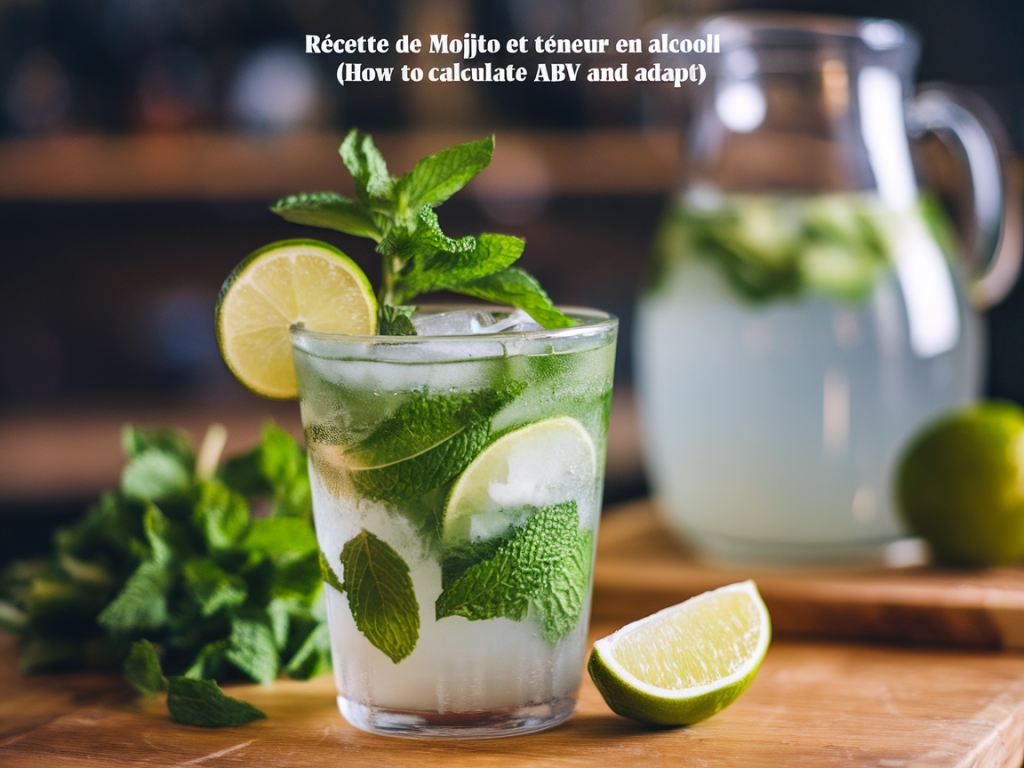
I like cocktails that are forgiving: easy to make, bright in flavor, and adjustable so a group of friends (or I) can dial them up or down depending on the night. The mojito is one of those classics—clean, minty, lime-forward—and yet people rarely ask the practical question I care about: how much alcohol is actually in a glass? In this piece I’ll walk you through a practical guide on recette de mojito et teneur en alcool, how to calculate ABV (alcohol by volume) for your homemade versions, and simple swaps to adapt strength and flavor without ruining the drink.
Why the ABV of a mojito matters
On paper a mojito is a short cocktail: white rum, fresh lime juice, sugar (or syrup), mint, and sparkling water. But that simple list hides a lot of variability. The ABV of the finished drink depends on the type and quantity of rum used, how much dilution you add (ice melt, soda), and the glass size. Knowing the math means you can decide whether to make a sessionable pitcher for a backyard party or a stiffer two-drink evening.
Basic mojito recipe I use (baseline for calculations)
Here’s the recipe I tend to start with when I want a balanced mojito. It’s my baseline for all the math that follows:
With this formula, we have a clear volume and a rum ABV (40%) to plug into the math.
How to calculate ABV of a cocktail (simple method)
I keep things practical, so here’s a quick method I use at home that’s accurate enough for kitchen use:
Example with the baseline recipe:
That means the mojito I described is similar in strength to a light wine (~11–12% ABV). But remember: if you add less soda, increase rum, or use a higher-proof spirit, the number goes up quickly.
Quick reference table: ABV by rum and proportion
| Rum (ABV) | Rum volume | Estimated final volume | Estimated cocktail ABV |
|---|---|---|---|
| 40% | 30 ml | 155 ml | 7.7% |
| 40% | 50 ml | 175 ml | 11.4% |
| 50% (overproof) | 50 ml | 175 ml | 14.3% |
| 35% (light rum) | 50 ml | 175 ml | 10.0% |
This table is approximate: final volume changes with the amount of soda and ice melt. Think of it as a practical guide rather than lab-grade accuracy.
Examples of common variations and their ABV impact
Here are real-world scenarios I watch for when tailoring a mojito:
How dilution (ice melt and soda) changes the math
People underestimate dilution. Crushed ice melts faster, diluting the drink and lowering ABV over time. Soda water also reduces ABV by adding non-alcoholic volume. When I make pitchers I intentionally add more soda so guests can sip longer without getting too tipsy.
- Rule of thumb: 1 cup of melting ice adds ~30–60 ml of water depending on temperature and starting ice volume.
- Carbonation affects perception: a fizzy, lower-ABV mojito can feel more refreshing than a still, stronger one.
Practical tips to adapt the strength without losing balance
Here are swaps I use when I want to change the drink’s power level but keep the flavor profile intact.
Measuring alcohol intake: standard drinks and safety
It helps to translate cocktail ABV into standard drinks. In many countries a “standard drink” equals about 10–14 grams of pure alcohol. Using the baseline example (20 ml ethanol = ~15.8 g ethanol), that mojito is roughly 1.1–1.6 standard drinks depending on local definition.
Some stats to keep in mind:
Sources I referenced while writing (and you might want to bookmark):
Recipe variations with ABV estimates
I like to offer concrete alternatives so you can pick one that fits your evening.
Tasting notes and balancing flavor when changing ABV
Changing alcohol content changes temperature, mouthfeel, and perceived acidity. Here are the small adjustments I make so flavor remains coherent:
Tools I use to be precise (and you can too)
For predictable results, I keep a few simple tools in my home bar:
Common mistakes and how to avoid them
- Too much muddling: over-muddled mint becomes bitter. Gentle bruising releases aromatics without vegetal notes.
- Ignoring dilution: serve immediately if you want the initial ABV and taste; expect change over time with crushed ice.
- Using syrup blindly: swapping to a flavored syrup can change perceived strength even if ABV stays the same.
Additional resources and further reading
If you want to dive deeper into the math or see other cocktail ABV comparisons, these pages are useful: