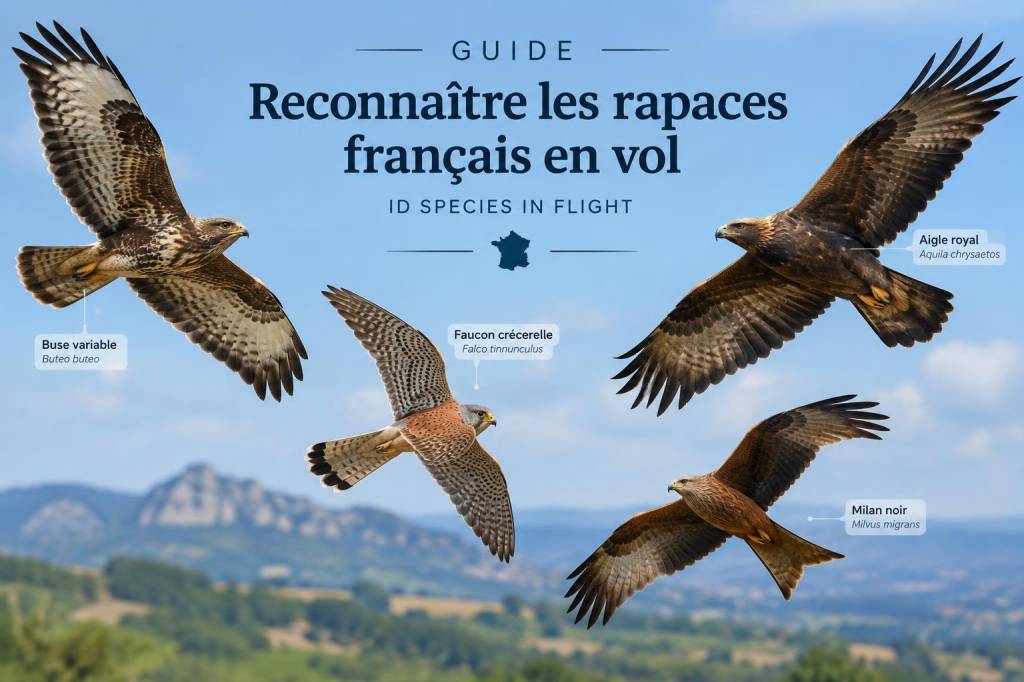
I have a confession: when I first tried to reconnaître les rapaces français en vol, I mixed up a buzzard and a kite more than once. Years of weekend walks, family outings, and hours with binoculars have taught me that recognising raptors in flight is as much about habits and silhouettes as it is about colours. This guide is my practical, field-tested approach to help you recognise the raptors of France — in the air and on the ground — using simple cues you can apply on a short walk with kids or a longer birding trip.
Why focus on recognising raptors in flight?
Raptors are often easiest to spot when they’re soaring, hunting, or perched high. For parents, teachers, and anyone trying to make birdwatching accessible to children (and impatient adults), learning in-flight ID pays off quickly: you can point out a bird at a distance, explain behaviour, and spark curiosity without getting close. Also, flight ID helps when plumage details are invisible and when juvenile birds look different from adults.
Key principles I use every time
- Start with size and silhouette: compare the bird to familiar shapes — crow-sized, goose-sized, or reminiscent of a kite.
- Note wing shape and flight style: long narrow wings with a stiff glide (e.g., falcons) vs broad rounded wings and slow flaps (e.g., buzzards).
- Look at tail: forked, square, or long and narrow — the tail is a huge clue in kestrels, kites and honey-buzzards.
- Observe patterns in motion: circling and soaring, hovering, fast direct flight or undulating flight near hedgerows.
- Context and habitat: marshes, cliffs, open fields or urban parks change the probability of species.
Quick reference: most common raptors in France (what I see most)
Below is a practical list of species you will commonly encounter and the single most useful ID trick for each one.
- Common Buzzard (Buteo buteo) — variable plumage; look for broad rounded wings and a short, fan-shaped tail while soaring.
- Red Kite (Milvus milvus) — distinctive deeply forked tail and buoyant, graceful flight with angled wings.
- Black Kite (Milvus migrans) — smaller and less reddish than red kite, slightly forked tail, often in groups near landfills or coasts.
- Common Kestrel (Falco tinnunculus) — hovers over open ground, small size, long tail and rapid wingbeats, male has rufous back.
- Peregrine Falcon (Falco peregrinus) — very fast, pointed wings and powerful stoops; often seen near cliffs or tall buildings.
- Long-eared Owl (Asio otus) — nocturnal but roosts in trees; slim silhouette with ear tufts visible when perched rather than in flight.
- Marsh Harrier (Circus aeruginosus) — low quartering flight over wetlands, long wings and tail, males grey-headed with a distinctive facial pattern.
- Honey-buzzard (Pernis apivorus) — long wings and small head, deliberate flapping then gliding; often migrates in groups.
- Goshawk (Accipiter gentilis) — powerful, fast through woodland with short rounded wings and long tail for manoeuvring.
Flight-style cheat sheet (easy to remember)
| Flight style | Typical species | Where to watch |
|---|---|---|
| Soaring in circles | Common Buzzard, Red Kite | Open countryside, thermals, ridgelines |
| Buoyant, level flight with forked tail | Red Kite | Valleys, open farmland |
| Hovering | Common Kestrel | Roadside, hedgerows, fields |
| Fast, direct flight with pointed wings | Peregrine, Hobby | Near cliffs, coasts, tall structures |
| Low quartering over reeds | Marsh Harrier | Wetlands and reedbeds |
Numbers and context — what you might expect to see
To set realistic expectations, here are some stats and trends based on French bird atlases and monitoring networks:
- Common Buzzard is one of the most numerous raptors in France — estimated hundreds of thousands across the country (Buteo buteo shows strong local populations).
- Red Kite populations have recovered in recent decades thanks to conservation measures; their numbers are increasing in many regions (source: LPO France).
- Migratory flows of Honey-buzzard and Osprey are highly seasonal; you’re most likely to see big movements in spring and autumn.
Field kit I always bring when teaching kids
- Binoculars (I like compact 8x42 for balancing magnification and ease of use).
- Smartphone with a bird ID app and camera — useful for quick photos to check later.
- Notebook and coloured pencils — kids love sketching wing shapes and tails.
- A printed silhouette chart — laminate it to keep it durable in the field.
How to lead a kid-friendly raptor watch
I run short, 30–45 minute sessions focused on fun facts and a few simple rules. Here’s my step-by-step:
- Start with a quick game: "big wings or small wings?" — helps them notice wing shape first.
- Teach one species at a time: pick the buzzard or kite — common and easy to spot.
- Use a story: explain hunting style (hovering kestrel) or migration journeys (honey-buzzard).
- Encourage photo-taking and lookups later — turning observation into a small research project helps retention.
Common ID pitfalls and how I avoid them
- Juvenile variation: many juveniles have streaked plumage that confuses beginners — focus on shape and flight first.
- Distant birds: avoid guessing colour at range — note silhouette and behaviour instead.
- Seasonal look-alikes: some species are only present during migration — use timing as a clue.
Useful resources I recommend
I regularly cross-check my observations with authoritative sources. Here are three that I find invaluable:
- Ligue pour la Protection des Oiseaux (LPO) — French raptor conservation data and sightings.
- BirdGuides — flight identification articles and images, especially useful for falcons and hawks.
- British Trust for Ornithology (BTO) — excellent migration studies and monitoring techniques relevant to Western Europe.
Examples from my field notes (real sightings)
These short case notes show how I applied the rules above:
- Late April, Loire valley: a group of honey-buzzards migrating south. Identified by their long wings, small head, and steady flapping-gliding pattern.
- Summer afternoon, suburban park: kestrel hovering above a sports field — clear hovering behaviour made ID instant for the kids.
- Autumn ridge, Brittany: red kites soaring low over a landfill site — unmistakable forked tails and reddish plumage even at distance.
When to use technology — apps and cameras
Modern tools can speed up learning:
- Smartphone apps like Merlin Bird ID or iNaturalist help confirm sightings from photos and recordings.
- A camera with a telephoto lens (300mm+) captures details that binoculars can miss — helpful for confirming juvenile plumage.
- Playback audio is rarely useful for raptors (most are silent in flight), so I avoid disturbing birds with sound lures.
Table: quick visual checklist for on-the-spot ID
| Feature | Buzzard | Kite | Falcon | Harrier |
|---|---|---|---|---|
| Wing shape | Broad, rounded | Long, narrowish | Pointed | Long, slender |
| Tail | Short, fan-shaped | Forked (red kite) | Long, narrow (kestrel) | Long, narrow, slightly V-shaped |
| Flight | Soaring, banking | Buoyant, graceful | Fast, direct; hovering (kestrel) | Quartering low |
Safety, ethics, and family-friendly rules
I always teach children to enjoy raptors without disturbing them. Simple ground rules I repeat:
- Keep a respectful distance — no chasing or startling birds.
- Avoid using playback or nest disturbance to get closer views.
- Teach children that conservation matters — explain how feeding, litter or habitat loss affects these species.
Further reading and data sources
For those who want to go deeper, these sources informed my guide and are great next steps:
- LPO — data and species profiles
- Avian Knowledge Network — migration and monitoring datasets
- BirdLife International — species accounts and conservation status
If you want a printable silhouette chart or a kid-friendly checklist I use on family walks, drop a comment and I’ll share a downloadable version. Meanwhile, keep your binoculars handy and watch the skies: once you learn the basics of how raptors move, the rest — the thrill of spotting a kestrel hover or a kite wheel on a thermal — comes naturally.